
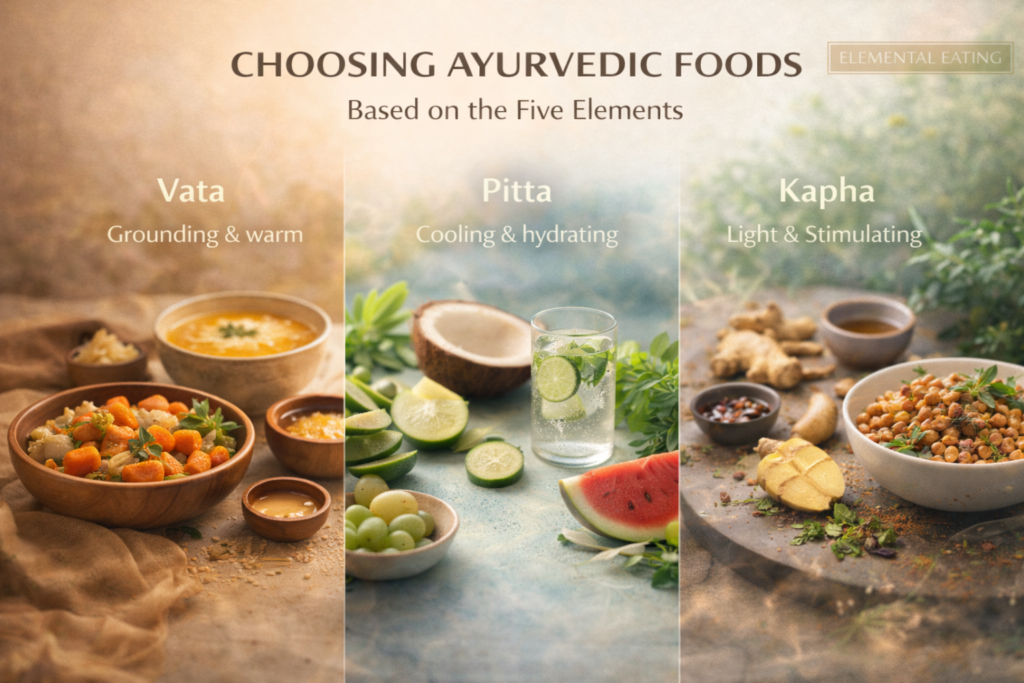
Ayurveda does not classify food as simply “healthy” or “unhealthy.” Instead, it teaches that food interacts with the five elements inside the body, and the same food can nourish one person while disturbing another.
According to Ayurveda, choosing the right food depends on elemental balance — earth, water, fire, air, and space — and how these elements influence digestion, energy, and stability. When food supports elemental harmony, digestion improves, energy stabilizes, and disease is prevented naturally.
The Five Elements in Ayurveda (Brief Overview)
All foods and bodies are composed of five elements (Pancha Mahabhutas):
- Earth (Prithvi) – Stability, heaviness, structure
- Water (Jala) – Fluidity, moisture, cohesion
- Fire (Agni) – Heat, transformation, digestion
- Air (Vayu) – Movement, dryness, circulation
- Space (Akasha) – Lightness, openness, expansion
Health depends on maintaining the right proportion of these elements, not eliminating any one of them.
Why Element-Based Food Selection Matters
Modern diets often ignore elemental impact and focus only on calories or nutrients. Ayurveda explains that:
- Excess fire leads to acidity and inflammation
- Excess air leads to gas, anxiety, and dryness
- Excess earth and water lead to heaviness and weight gain
Food either balances or aggravates these elements.
Choosing foods based on elements helps:
- Improve digestion
- Stabilize energy
- Prevent chronic imbalance
- Reduce dependence on corrective treatments
Foods That Increase Each Element
Understanding elemental influence helps make better choices.
Earth-Dominant Foods
Earth provides stability and nourishment.
Examples:
- Grains
- Root vegetables
- Dairy
- Nuts and seeds
Excess earth leads to heaviness and sluggish digestion.
Water-Dominant Foods
Water provides hydration and softness.
Examples:
- Fruits
- Soups
- Juicy vegetables
- Milk-based foods
Excess water causes congestion and lethargy.
Fire-Dominant Foods
Fire stimulates digestion and metabolism.
Examples:
- Spices
- Chilies
- Sour and fermented foods
- Alcohol
Excess fire causes acidity, heat, and inflammation.
Air-Dominant Foods
Air increases movement and lightness.
Examples:
- Dry foods
- Raw vegetables
- Crackers
- Beans
Excess air causes gas, bloating, anxiety, and dryness.
Space-Dominant Foods
Space promotes lightness and openness.
Examples:
- Fasting
- Very light foods
- Leafy greens
Excess space causes weakness and instability.
How to Choose Foods Based on Elemental Needs
If You Experience Excess Heat (Fire)
Choose foods that are:
- Mild
- Cooling
- Moist
Avoid excessive spices, alcohol, and sour foods.
If You Feel Heavy or Sluggish (Earth & Water)
Choose foods that are:
- Light
- Warm
- Digestible
Avoid overeating and heavy, oily meals.
If You Feel Dry, Anxious, or Bloated (Air & Space)
Choose foods that are:
- Warm
- Moist
- Nourishing
Avoid raw, cold, and dry foods.
Element Balance Depends on Digestion (Agni)
Ayurveda emphasizes that digestive fire determines how elements are processed.
Strong digestion:
- Handles a wider variety of foods
Weak digestion:
- Reacts even to simple foods
Thus, improving digestion is more important than rigid food restriction.
Seasonal & Daily Elemental Changes
Elemental dominance changes with:
- Season
- Time of day
- Age
- Lifestyle
Ayurveda advises adjusting food choices accordingly rather than following a fixed diet year-round.
Common Mistakes in Element-Based Eating
- Overusing raw foods for “health”
- Excess spicy foods for metabolism
- Skipping meals for lightness
- Ignoring digestion while changing diet
Balance, not extremes, is the Ayurvedic approach.
What Balanced Elemental Eating Feels Like
When foods match elemental needs, you may notice:
- Comfortable digestion
- Steady energy
- Reduced cravings
- Better sleep
- Improved mood
- Lightness without weakness
These are signs of harmony, not restriction.
Final Thought
Ayurveda teaches that food is medicine only when it respects elemental balance. Choosing foods based on elements allows the body to digest, absorb, and utilize nourishment efficiently.
There is no universal diet only appropriate eating based on balance, digestion, and context.
True nourishment comes not from eating more or less, but from eating in alignment with your internal elements.
Frequently Asked Questions (FAQ)
1. What does it mean to choose foods based on elements in Ayurveda?
It means selecting foods according to how they influence the five elements in the body, helping maintain balance rather than causing excess heat, dryness, or heaviness.
2. Can the same food affect people differently?
Yes. The same food may balance one person and aggravate another depending on digestion, elemental dominance, and lifestyle.
3. How do I know which element is imbalanced in me?
Symptoms like acidity (fire), bloating (air), heaviness (earth/water), or weakness (space) indicate which elements may be excessive.
4. Are spicy foods bad according to Ayurveda?
Spicy foods are not bad, but excess spice increases the fire element and can cause acidity and inflammation if digestion is not balanced.
5. Is raw food always healthy?
No. Raw foods increase air and space elements and may cause bloating or weakness, especially in people with sensitive digestion.
6. Is digestion more important than food type?
Yes. Ayurveda emphasizes that strong digestion matters more than specific food choices, as digestion determines how elements are processed.