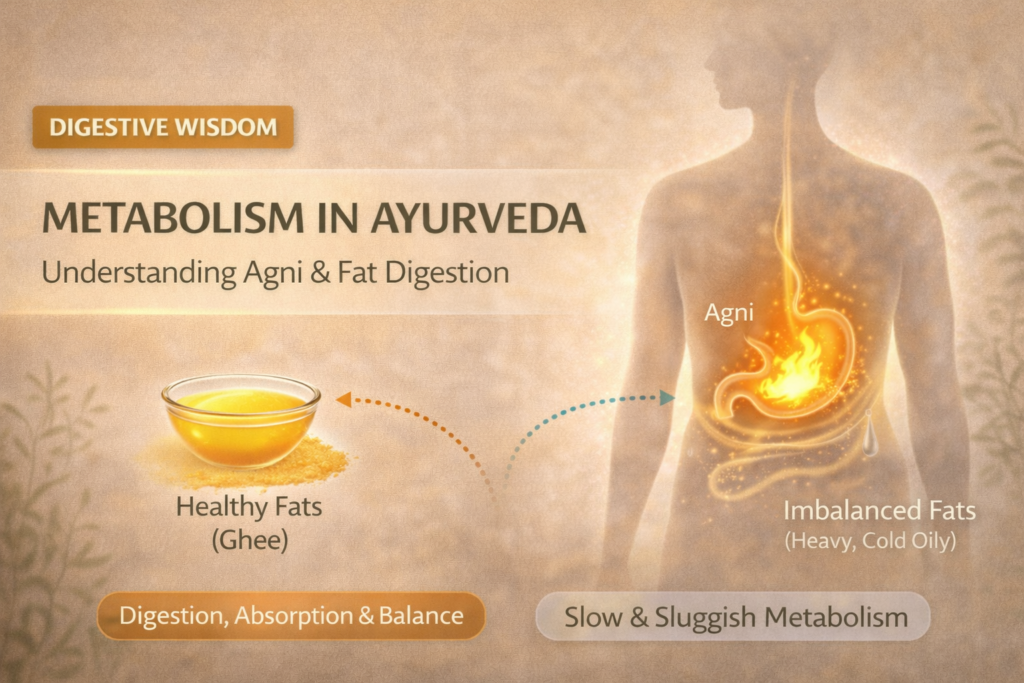
In Ayurveda, metabolism is not reduced to calorie burning or fat breakdown alone. It is understood as a complex, intelligent process governed by Agni — the digestive and metabolic fire that controls how food is digested, absorbed, transformed, and eliminated.
When metabolism is healthy, the body maintains energy, clarity, and balanced weight naturally. When it is disturbed, issues like weight gain, fatigue, acidity, bloating, and poor fat digestion begin to appear.
Understanding Agni is the key to understanding metabolism in Ayurveda.
What Is Agni in Ayurveda?
Agni literally means fire, but in Ayurveda it represents all digestive and metabolic processes in the body.
Agni governs:
- Digestion of food
- Absorption of nutrients
- Metabolism at tissue level
- Fat processing
- Detoxification
- Energy production
Ayurveda does not consider metabolism as one single process — it sees multiple levels of Agni working together.
Types of Agni and Their Role in Metabolism
1. Jatharagni – Central Digestive Fire
Located in the digestive tract, Jatharagni is responsible for breaking down food.
If Jatharagni is:
- Balanced → food is digested properly
- Weak → food turns into toxins (Ama)
- Excessive → acidity, inflammation, tissue damage
Healthy fat digestion begins here.
2. Bhutagni – Nutrient Transformation
After digestion, nutrients are refined and made usable for the body.
Proper Bhutagni ensures:
- Nutrients reach tissues correctly
- Fat is utilized, not stored
- Energy is produced efficiently
3. Dhatvagni – Tissue-Level Metabolism
Each body tissue has its own metabolic fire.
Dhatvagni governs:
- Fat tissue metabolism
- Muscle nourishment
- Hormonal balance
- Tissue regeneration
If Dhatvagni is weak, fat accumulates even with controlled diet.
How Ayurveda Understands Fat Digestion
Unlike modern views that label fat as “good” or “bad,” Ayurveda evaluates fat based on:
- Digestive strength
- Type of fat
- Quantity
- Individual constitution
- Timing of intake
Fat digestion depends on stable Agni, not fat avoidance.
Why Fat Accumulates (Ayurvedic View)
Fat accumulation occurs when:
- Digestion is sluggish
- Food is incompletely processed
- Toxins (Ama) block metabolic pathways
- Kapha dosha becomes dominant
- Tissue metabolism slows
This is why many people struggle to lose fat despite eating less — metabolism is blocked, not overeating alone.
Ama: The Metabolic Blocker
Ama is sticky, toxic residue formed from improper digestion.
Signs of Ama include:
- Heaviness
- Lethargy
- Bloating
- Poor fat loss response
- Low motivation
- Slow metabolism
As long as Ama is present, fat digestion remains inefficient.
Strong vs Weak Metabolism in Ayurveda
Signs of Balanced Agni
- Regular appetite
- Lightness after meals
- Stable energy
- Easy digestion of fats
- Healthy weight maintenance
- Clear bowel movements
Signs of Disturbed Agni
- Bloating
- Acidity
- Cravings
- Fat gain despite effort
- Fatigue
- Irregular appetite
Why Calorie Counting Alone Fails
Ayurveda explains why calorie-focused approaches often fail:
- They ignore digestive capacity
- They weaken Agni
- They increase stress hormones
- They cause rebound fat storage
Sustainable fat digestion requires metabolic correction, not restriction.
Ayurvedic Approach to Improving Metabolism
1. Stabilize Digestive Fire
Metabolism improves when digestion is regular, not aggressive.
This includes:
- Fixed meal timings
- Warm, freshly prepared food
- Avoiding overeating and skipping meals
2. Reduce Ama Gradually
Gentle daily detox practices clear metabolic blocks, allowing fat digestion to resume naturally.
3. Balance Doshas
Kapha imbalance slows metabolism, while excess Pitta causes inflammation and erratic fat burning. Balance is key.
4. Support Tissue Metabolism
Ayurveda focuses on long-term tissue health, not short-term fat loss.
Exercise & Agni
Exercise supports metabolism when done correctly.
Ayurveda advises:
- Moderate intensity
- Consistency over intensity
- Exercise aligned with strength and season
Over-exercising weakens Agni and slows fat digestion over time.
When Fat Digestion Becomes Natural
In Ayurveda, when:
- Digestion is strong
- Ama is reduced
- Tissue metabolism is active
- Routine is stable
Fat is used as energy instead of being stored.
Weight stabilizes without force.