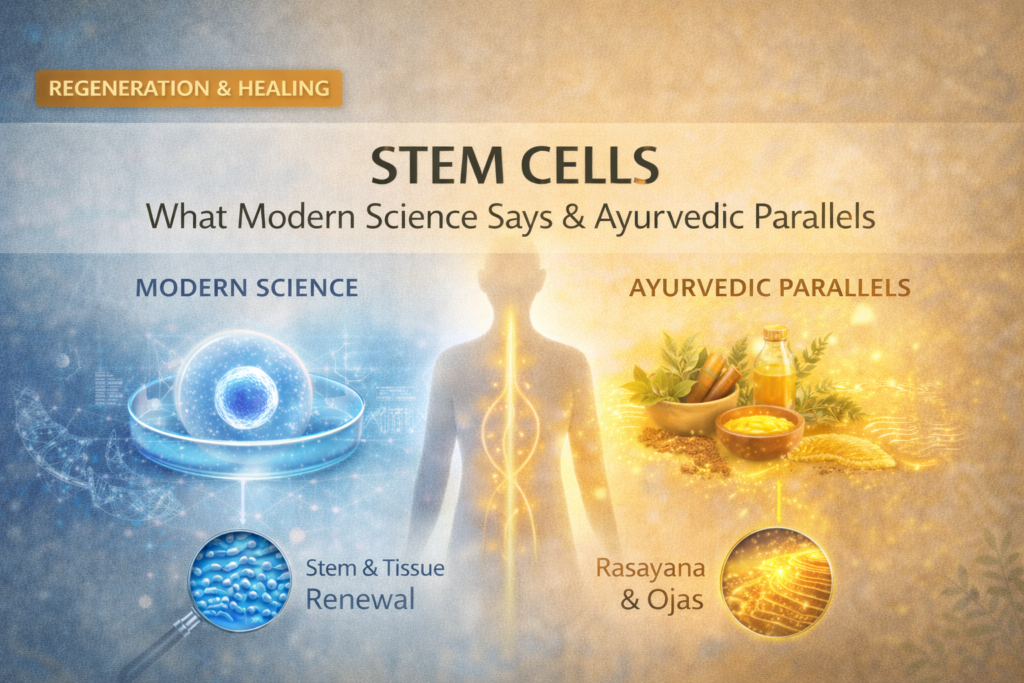
Stem cells are often described as the body’s repair system. Modern science recognizes them as undifferentiated cells with the ability to regenerate, repair damaged tissues, and maintain organ health. As research expands, stem cells are increasingly linked to healing, longevity, and regenerative medicine.
Interestingly, Ayurveda has spoken about regeneration, tissue renewal, and healing intelligence for thousands of years, though using a very different language. While Ayurveda does not describe stem cells anatomically, its foundational principles closely mirror the functional role that stem cells play in the body.
Understanding both perspectives offers a deeper, more holistic view of healing and regeneration.
What Modern Science Says About Stem Cells
From a biomedical perspective, stem cells are unique because they can:
- Self-renew (make more stem cells)
- Differentiate into specialized cells
- Repair damaged tissues
- Support organ regeneration
They play a crucial role in:
- Growth and development
- Tissue maintenance
- Healing after injury
- Immune function
There are different types of stem cells, including embryonic stem cells, adult stem cells, and induced pluripotent stem cells, each with specific functions and ethical considerations.
The Limits of a Purely Mechanical View
While modern science explains how stem cells work, it often focuses on:
- Isolated cells
- External interventions
- Disease-specific repair
What it explores less deeply is why the body sometimes fails to regenerate, or why healing capacity varies so widely between individuals.
This is where Ayurvedic understanding becomes relevant.
Ayurvedic View of Regeneration (A Functional Parallel)
Ayurveda does not describe stem cells as physical entities. Instead, it explains regeneration through systems and principles that govern tissue formation and renewal.
Key Ayurvedic concepts that parallel stem cell function include:
1. Dhatus: The Tissue System
Ayurveda describes seven tissues (Dhatus) that build and sustain the body:
- Plasma
- Blood
- Muscle
- Fat
- Bone
- Nervous tissue
- Reproductive tissue
Each tissue is formed sequentially and nourished through proper digestion and metabolism.
This system mirrors modern understanding that cellular regeneration depends on nutrient availability and metabolic intelligence, not just the presence of cells.
2. Dhatvagni: Tissue-Level Metabolism
Each tissue has its own metabolic intelligence (Dhatvagni), responsible for:
- Proper tissue formation
- Repair and regeneration
- Preventing degeneration
If Dhatvagni is weak, tissues fail to regenerate efficiently — even if stem cells are present.
This aligns with modern findings that cellular repair depends on the internal environment, not just regenerative cells.
3. Ojas: The Essence of Vitality
Ojas is considered the refined essence of all tissues and the foundation of:
- Immunity
- Strength
- Healing capacity
- Longevity
From a parallel perspective, Ojas reflects the body’s ability to support regeneration, similar to how stem cell environments must be favorable for repair to occur.
Without Ojas, healing becomes slow and incomplete.
4. Agni: The Regenerative Intelligence
Ayurveda places digestion and metabolism (Agni) at the center of regeneration.
If nutrients are poorly digested:
- Tissue repair weakens
- Regeneration slows
- Healing becomes incomplete
Modern science increasingly recognizes that cellular repair depends on metabolic health, inflammation control, and nutrient utilization — concepts Ayurveda emphasized long ago.
Why Regeneration Fails (Ayurvedic Explanation)
Ayurveda explains poor regeneration through:
- Weak digestion
- Toxin accumulation (Ama)
- Chronic inflammation
- Stress and nervous system imbalance
- Improper lifestyle and routine
These factors create an internal environment where even advanced regenerative mechanisms cannot function optimally.
Modern research similarly shows that chronic inflammation, stress hormones, and poor metabolic health inhibit stem cell activity.
Regeneration vs Replacement
Modern medicine often focuses on replacement — introducing stem cells externally.
Ayurveda emphasizes restoration — improving the internal environment so the body’s natural regenerative intelligence can function.
These are not opposing views, but complementary ones.
Where Both Systems Meet
Modern science and Ayurveda agree on key points:
- Regeneration depends on internal balance
- Chronic inflammation blocks healing
- Metabolism plays a central role
- The body has innate intelligence for repair
Ayurveda adds an important insight:
Regeneration is not forced — it is enabled.
A Long-Term Healing Perspective
While stem cell therapies show promise, Ayurveda reminds us that:
- Regeneration must be supported daily
- Tissue health depends on digestion and routine
- Healing capacity declines when lifestyle is misaligned
Sustainable regeneration is not an event — it is a process.