
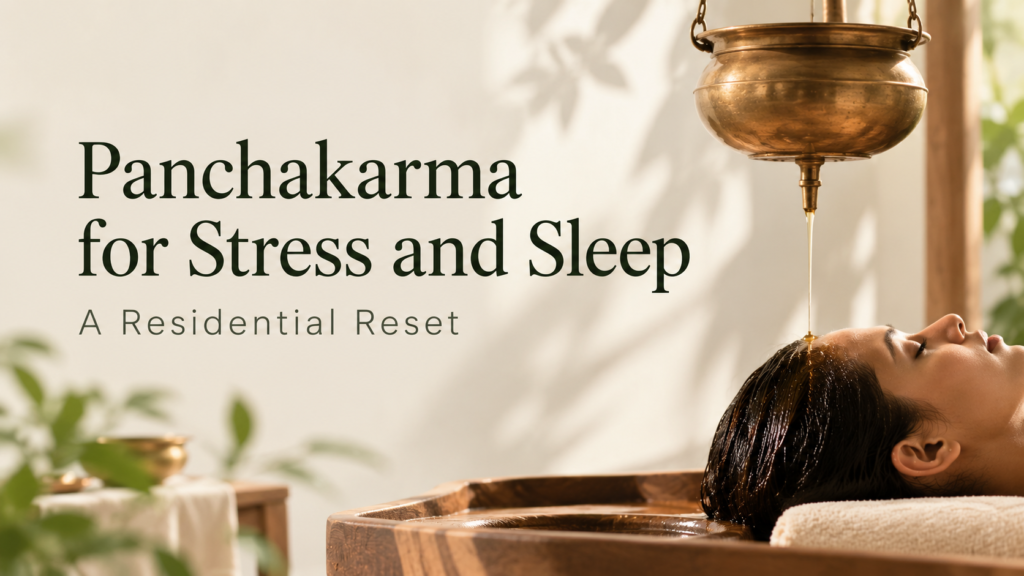
Panchakarma for stress and sleep is a supervised residential reset. A doctor-led programme combines calming therapies such as Shirodhara and Abhyanga, a gentle cleansing therapy where suitable, warm regular meals, yoga and a strict evening routine. Over one to two weeks, the aim is to calm an overworked nervous system and rebuild a healthy sleep rhythm you can keep at home.
Stress and poor sleep feed each other. A tired mind handles pressure badly, and a stressed mind struggles to switch off at night. In a 2025 LocalCircles survey of more than 43,000 responses from 348 districts, 59% of people in India said they get less than six hours of uninterrupted sleep a night (Deccan Herald, March 2025).
Work stress adds to the strain. A McKinsey Health Institute survey found that 59% of respondents in India reported burnout symptoms, the highest of the 30 countries studied (IANS, 2023).
When weekends and holidays no longer restore you, a structured reset can help. This guide explains how Panchakarma for stress works, how Ayurveda approaches insomnia, what a sleep-focused stay includes, and how to keep the benefits at home. It sits alongside IVAC’s Ayurvedic stress management programme.
Stress, burnout and sleep in Ayurveda
Ayurveda sees long-term stress as a slow build-up of Vata, the dosha of movement, which leaves the mind restless and the body dry, tense and tired. Sleep, called Nidra, is described as one of the three pillars of health, alongside food and balanced living. When Vata rises, sleep becomes light and broken, and the cycle of fatigue and stress tightens.
Ayurvedic doctors often see a familiar pattern in people with stress and burnout:
- Light, broken sleep: difficulty falling asleep, or waking in the early hours and lying awake
- A busy mind: racing thoughts, irritability and difficulty switching off
- Physical tension: stiff neck and shoulders, headaches, cold hands and feet
- Irregular digestion: skipped meals, late dinners, bloating or poor appetite
The aim of treatment is not just more hours in bed. It is to settle Vata, steady the daily rhythm and restore the body’s natural pull towards sleep at the right time. If poor sleep is your main concern, read our article on why insomnia matters.
Panchakarma for stress: how it works
Panchakarma for stress follows the usual three stages, preparation, a main therapy and recovery, but adapted to calm rather than to cleanse hard. Preparation uses warm oil therapies and steam. The main therapy is usually a gentle course of Basti, which Ayurveda considers the key treatment for Vata. Shirodhara and quiet routine run through the whole stay.
- Preparation. Daily Abhyanga and herbal steam relax the body and settle the nervous system.
- Main therapy. A course of Basti, mostly oil-based, to balance Vata. Stronger cleansing therapies are used only if the doctor finds them suitable.
- Calming therapies. Shirodhara, Shiro Pichu or foot massage, often in the late afternoon or evening.
- Recovery. A gentle return to normal food and a routine designed to protect sleep.
Research is early but points in a useful direction. An exploratory study of 101 adults found that signs of Vata imbalance were linked to more anxiety, more rumination and lower quality of life (Journal of Ayurveda and Integrative Medicine, 2019). In a small Harvard-affiliated study of 20 women on a 5-day Panchakarma programme, quality of life did not change significantly, but healthy behaviours and confidence in self-care improved, and depression scores had improved three months later (Conboy et al., 2009).
The lesson is that Panchakarma works best as a reset that helps new habits stick, rather than as a quick fix. Read more about Panchakarma treatment.
Ayurvedic treatment for insomnia
Ayurvedic treatment for insomnia combines calming evening therapies, such as Shirodhara, head oil massage and foot massage, with a strict daily rhythm: an early, light dinner, no screens before bed and a fixed sleep time. The doctor also looks at digestion and stress, since Ayurveda treats poor sleep as a sign of wider imbalance rather than a problem on its own.
| Therapy | What happens | Why it is used for sleep |
|---|---|---|
| Shirodhara | Warm oil poured steadily over the forehead | Traditionally used to quiet a busy mind |
| Takradhara | A steady stream of medicated buttermilk over the forehead | A cooling variation, often used when the mind feels heated or irritable |
| Shiro Abhyanga | Warm oil massage of the head and scalp | Releases tension in the head, neck and shoulders |
| Padabhyanga | Warm oil massage of the feet before bed | A simple evening ritual that guests can continue at home |
| Nasya | Medicated oil drops through the nose | Sometimes used for head tension and restless sleep |
Table: Ayurvedic therapies commonly used to support sleep. Your doctor decides which suit you.
An honest note on long-term insomnia: For chronic insomnia, the American College of Physicians recommends cognitive behavioural therapy for insomnia (CBT-I) as the first treatment for all adults (ACP guideline, Annals of Internal Medicine, 2016). Ayurvedic care can sit comfortably alongside CBT-I, since both focus on routine and habits. If you have had trouble sleeping for months, or snore heavily and wake unrefreshed, see a doctor to rule out conditions such as sleep apnoea.
Sleep disorder retreat in India: what a stay includes
A sleep-focused Ayurvedic retreat in India is built around the evening as much as the day. Expect morning yoga, a doctor review, one or two calming therapies, a main meal at midday, quiet afternoons, an early light dinner and a wind-down routine that ends with lights out at a fixed time. Most programmes run for 7 to 14 nights.
| Time | What happens |
|---|---|
| 6:30 am | Wake at a fixed time; gentle yoga and slow breathing |
| 8:00 am | Warm, light breakfast |
| 9:00 am | Doctor review: last night’s sleep, energy and mood |
| 10:00 am | Abhyanga and steam, or the day’s main therapy |
| 1:00 pm | Lunch, the main meal of the day |
| 2:30 pm | Rest, reading or a walk outdoors; no long daytime naps |
| 5:00 pm | Shirodhara or another calming therapy |
| 6:30 pm | Light, early dinner |
| 8:30 pm | Screens away; foot massage, Yoga Nidra or quiet reading |
| 9:30 pm | Lights out |
Table: a sample day on a sleep-focused Ayurvedic programme. Timings are a guide; your doctor adjusts them for you.
Two habits sit at the centre of the programme. First, keeping the same wake-up time every day, even after a poor night. Second, protecting the last hour before bed from screens and work. Both are hard at home and easy at a retreat, which is why the stay works as a reset.
Your routine after the retreat
The benefits of a stress and sleep retreat last only as long as the routine that supports them. Before you leave, your doctor should give you a short written plan: fixed sleep and wake times, an early dinner, a simple evening wind-down and a few minutes of yoga or breathing each day. Start small and keep it steady.
A simple plan to take home:
- Keep your wake-up time fixed, including weekends.
- Eat dinner early and light, at least two to three hours before bed.
- Protect the last hour before sleep: dim lights, no work, no scrolling.
- Repeat one evening ritual, such as a warm oil foot massage or slow breathing.
- Move every morning, even if it is only ten minutes of yoga or a short walk.
- Plan your next reset. A short stay each year can help you stay on track.
If sleep problems return and last for weeks, speak to your doctor. If stress turns into persistent low mood or anxiety, seek support from a mental health professional; our guide to Ayurvedic treatment for anxiety explains how Ayurvedic care fits alongside that support.
Panchakarma for stress and sleep at IVAC, Mysuru
At Indus Valley Ayurvedic Centre (IVAC), stress and sleep programmes begin with a doctor’s assessment of your sleep, digestion, stress and medicines, followed by daily doctor reviews. Calming therapies, a gentle Panchakarma course where suitable, Sattvic meals, yoga and a protected evening routine make up the stay. Programmes run alongside any treatment from your own doctor.
What a stay at IVAC includes:
- A free 20-minute call with an IVAC doctor before you book
- A full consultation on arrival and daily doctor reviews
- Calming therapies such as Shirodhara and Abhyanga, chosen for you
- A gentle Panchakarma course where the doctor finds it suitable
- Sattvic meals at fixed times, with an early dinner
- Daily yoga, breathing and an evening wind-down
- A written routine to continue at home
IVAC was founded by Dr. Talavane Krishna, a Western-trained doctor (MBBS, FFARCS UK), and has welcomed guests from more than 50 countries since 1999. Mysuru is about two hours from Bengaluru by road or rail.
[EXPERT QUOTE NEEDED: one or two lines from an IVAC doctor on what changes for guests when sleep and routine are restored]
Your next step: Explore IVAC’s Ayurvedic stress management programme and book a free 20-minute call with an IVAC doctor. Our doctors will assess your case before recommending any programme.
Frequently asked questions
Is Panchakarma good for stress?
Panchakarma can help as part of a supervised programme that also changes routine, food and sleep. For stress, it is adapted to calm rather than cleanse hard, using oil therapies, a gentle course of Basti and Shirodhara. Early research suggests it may help people adopt healthier habits. It works best as a reset, not a quick fix.
Can an Ayurveda retreat help with sleep?
An Ayurveda retreat can support better sleep by combining calming evening therapies, an early light dinner, no screens before bed and a fixed sleep and wake time, all under supervision. For long-term insomnia, guidelines recommend cognitive behavioural therapy for insomnia (CBT-I) first, and Ayurvedic care can sit alongside it.
How long should a stress retreat be?
Most stress and sleep programmes run for 7 to 14 nights. A week allows calming therapies and a new routine to begin. Two weeks allows a full, gentle Panchakarma course and more time for sleep to settle. Your doctor will recommend a length after understanding your health, stress and sleep pattern.
What is the best Ayurvedic treatment for insomnia?
There is no single best treatment. Shirodhara is the therapy most often used for a busy mind, alongside head and foot massage, an early dinner and a fixed bedtime. A doctor chooses the combination after looking at your sleep, digestion and stress. If insomnia has lasted months, see a doctor to rule out other causes.
Can I continue my sleep or anxiety medicines during the retreat?
Yes. Keep taking any prescribed medicines exactly as directed, and tell the Ayurvedic doctor about all of them before you arrive, since some herbs can interact with sleep or mood medicines. Never stop or reduce them without speaking to the doctor who prescribed them. Consult a qualified doctor before making changes.
Is Panchakarma safe if I feel completely burnt out?
Usually yes, if it is adapted. When someone is exhausted, a good doctor starts with rest, nourishing oil therapies and sleep before any stronger cleansing, and may skip intense therapies altogether. Tell the doctor how depleted you feel, so the programme can be paced to your energy. Our doctors will assess your case before recommending any programme.
Key takeaways
- Ayurveda links stress and poor sleep to excess Vata, and treats them together.
- Panchakarma for stress is gentle: oil therapies, a course of Basti and Shirodhara, paced to your energy.
- For chronic insomnia, CBT-I comes first, and Ayurvedic care can support it.
- A fixed wake time and a protected last hour before bed are the habits most worth keeping at home.
About the author
Dr. Belaku Chandu is a Senior Ayurvedic Consultant at Indus Valley Ayurvedic Centre (IVAC), Mysuru, and assesses guests and plans their stress, sleep and Panchakarma programmes.
This article is for general information. It does not replace advice from a doctor or mental health professional. Do not stop or change prescribed medicines without your doctor’s advice. Our doctors will assess your case before recommending any programme.