
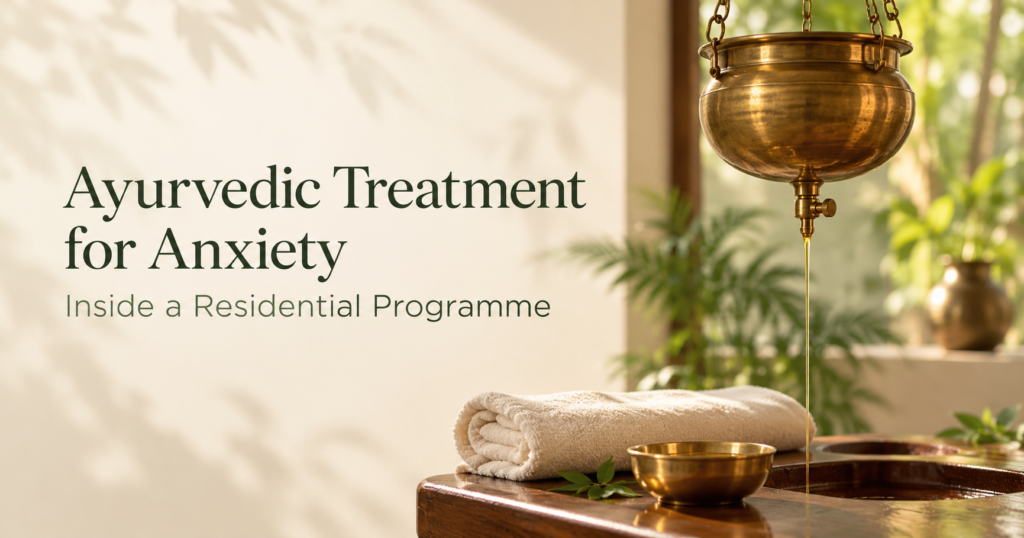
Ayurvedic treatment for anxiety focuses on calming Vata, the dosha of movement, and steadying the mind through daily routine. In a residential programme, that means therapies such as Shirodhara and Abhyanga, warm regular meals, gentle yoga and breathing, and protected sleep, all under a doctor’s supervision. It works alongside, never instead of, the care of your own doctor or mental health professional.
Anxiety is common, and most people living with it never get help. India’s National Mental Health Survey, run by NIMHANS, found that 10.56% of adults currently live with a mental health condition, with neurotic and stress-related disorders, which include anxiety, among the most common. The treatment gap was 84.5% (Gautham et al., International Journal of Social Psychiatry, 2020).
Many people look for care that also addresses sleep, digestion, routine and the pace of daily life. Ayurveda has long treated the mind and body together, and a residential programme gives that approach the time and calm it needs.
This guide explains how Ayurveda understands anxiety, which therapies are used, what a stay involves, and when to seek medical or mental health support first. It sits alongside IVAC’s Ayurvedic stress management programme.
How Ayurveda understands anxiety
Ayurveda sees anxiety mainly as an imbalance of Vata, the dosha of movement, which in excess makes the mind restless, the breath shallow and sleep light. It also looks at the qualities of the mind itself: Sattva (clarity and calm), Rajas (activity and agitation) and Tamas (heaviness and dullness). Treatment aims to settle Vata and strengthen Sattva.
An Ayurvedic doctor will usually ask about:
- Sleep: how long you sleep, how often you wake, and whether you feel rested
- Digestion: appetite, bloating and irregular meals, which Ayurveda links closely to the mind
- Daily rhythm: work hours, screen time, travel and late nights, all of which can aggravate Vata
- Body signs: dryness, tension, cold hands and feet, or a racing heart
This view does not replace a psychiatric or psychological diagnosis. It adds a way of looking at the whole person, so that routine, food and rest become part of care.
Ayurvedic treatment for anxiety: therapies used
Ayurvedic treatment for anxiety uses calming therapies that work through warmth, oil, rhythm and touch. The most common are Shirodhara, a steady stream of warm oil over the forehead; Abhyanga, a warm oil massage; and gentle head and foot therapies. Herbal medicines may be added by the doctor, but only after checking them against any medicines you already take.
| Therapy | What happens | Why it is used |
|---|---|---|
| Shirodhara | Warm medicated oil poured in a steady stream over the forehead | Traditionally used to calm the mind and support sleep (read more) |
| Abhyanga | Warm herbal oil massage of the whole body | Grounds Vata and relaxes muscle tension |
| Shiro Pichu | A cloth soaked in warm oil rested on the crown of the head | A gentle, quieter alternative for restlessness |
| Padabhyanga | Warm oil massage of the feet | Often used in the evening to support sleep |
| Nasya | Medicated oil drops given through the nose | Sometimes used for head tension and a restless mind |
Table: calming therapies commonly used in Ayurvedic care for anxiety. Your doctor decides which suit you.
Research on these specific therapies for anxiety is limited and mostly small. The strongest evidence is for yoga, which is part of every programme. A meta-analysis of 8 randomised trials with 319 participants found small short-term benefits of yoga for people with elevated anxiety, with no increase in injuries, though evidence for diagnosed anxiety disorders was inconclusive (Cramer et al., Depression and Anxiety, 2018).
About herbal medicines: Some Ayurvedic herbs can interact with medicines for anxiety, depression or sleep. Never start herbs on your own, and always tell the Ayurvedic doctor and your own doctor everything you take.
Daily routine, food and yoga
In Ayurveda, a steady daily routine is one of the most important tools for a restless mind. Regular waking and sleeping times, warm meals at fixed hours, gentle yoga and slow breathing all help settle Vata. These are simple habits, but they are hard to build during a busy week, which is where a residential stay helps.
Routine:
- Wake and sleep at the same times each day
- Keep mornings calm, without checking the phone straight away
- Build in short pauses through the day for slow breathing
Food:
- Warm, freshly cooked meals, with lunch as the main meal
- Fewer stimulants such as strong coffee, especially later in the day
- Regular meal times, since skipped meals can worsen restlessness
Yoga and breathing:
- Gentle postures that release the neck, shoulders and back
- Slow breathing practices, taught step by step
- A short relaxation or Yoga Nidra session before sleep
None of these replaces professional mental health care. Together, they create conditions in which the mind can settle and other treatment can work better.
A residential stay vs home routines
A residential stay removes the daily triggers that keep the mind on alert, such as work messages, traffic, late nights and irregular meals, for long enough to build new habits. Home routines are where those habits must last. The most useful programmes do both: a supervised stay to reset, then a simple plan to continue at home.
| Home routine alone | Residential Ayurvedic stay | |
|---|---|---|
| Daily triggers | Still present: work, screens, traffic | Removed for the length of the stay |
| Therapies | Occasional, if available locally | Daily, chosen by a doctor |
| Food and sleep | Easy to slip on busy days | Planned and protected |
| Supervision | Self-guided | Daily doctor review |
| Best for | Mild, occasional stress | Building a calmer routine, or after a period of strain |
Table: how a residential stay compares with home routines for anxiety and stress.
Most residential programmes for stress and anxiety run for 7 to 14 nights. A longer stay gives more time for sleep and digestion to settle. Before you leave, the doctor should give you a written routine to follow at home.
When to seek medical or mental health support
Seek medical or mental health support before, or alongside, any Ayurvedic programme if anxiety is severe, persistent or getting in the way of daily life. A doctor should also check for physical causes of symptoms such as a racing heart or breathlessness. Ayurveda can support your care, but it is not a substitute for assessment by a qualified professional.
Speak to a doctor or mental health professional if:
- Anxiety lasts for weeks or keeps returning
- You have panic attacks, or avoid places and people because of fear
- Sleep, work or relationships are seriously affected
- You have chest pain, breathlessness or palpitations, which need medical checks first
- You are already on medicines for anxiety, depression or sleep and want to add other care
If you are struggling right now: In India, you can call Tele-MANAS, the government’s free 24×7 mental health helpline, on 14416 or 1-800-891-4416. It offers counselling in many languages and can refer you for further care (Vikaspedia, Tele-MANAS). If you or someone else is in immediate danger, call 112.
Never stop or change prescribed medicines for anxiety, depression or sleep without speaking to the doctor who prescribed them.
Ayurvedic care for anxiety at IVAC, Mysuru
At Indus Valley Ayurvedic Centre (IVAC), care for stress and anxiety begins with a doctor’s assessment of your health, sleep, digestion and current medicines. Programmes combine calming therapies such as Shirodhara and Abhyanga, warm meals, daily yoga and breathing, and a quiet setting, with daily doctor reviews. They run alongside the care of your own doctor or therapist.
What a stay at IVAC includes:
- A free 20-minute call with an IVAC doctor before you book
- A full consultation on arrival and daily doctor reviews
- Calming therapies chosen for you, adjusted as you settle
- Sattvic meals at regular times
- Daily yoga, breathing and relaxation practice
- A written routine to continue at home
IVAC was founded by Dr. Talavane Krishna, a Western-trained doctor (MBBS, FFARCS UK), and has welcomed guests from more than 50 countries since 1999.
Your next step: Explore IVAC’s Ayurvedic stress management programme and book a free 20-minute call with an IVAC doctor. Our doctors will assess your case before recommending any programme.
Frequently asked questions
Can Ayurveda help with anxiety?
Ayurveda may help ease everyday anxiety and stress as part of a wider plan. It focuses on calming Vata through therapies such as Shirodhara, a steady daily routine, warm meals, yoga and good sleep. Evidence is strongest for yoga. Ayurveda should be used alongside, not instead of, care from a doctor or mental health professional.
Which Ayurvedic therapy is used for anxiety?
Shirodhara, a steady stream of warm oil over the forehead, is the therapy most often used for a restless mind. Abhyanga (warm oil massage), Shiro Pichu, foot massage and Nasya may also be included. A doctor chooses the combination after assessing your health, sleep and digestion, and adjusts it during your stay.
Can I continue my medication during an Ayurvedic programme?
Yes. Keep taking any medicines for anxiety, depression or sleep exactly as prescribed. Share a full list with the Ayurvedic doctor before you arrive, because some herbs can interact with these medicines. Never stop or change prescribed medicines without speaking to the doctor who prescribed them. Consult a qualified doctor before making changes.
Is Shirodhara good for anxiety?
Shirodhara is traditionally used in Ayurveda to calm the mind and support sleep, and is usually a quiet, restful experience. Research on Shirodhara specifically for anxiety is still limited and small. It works best as part of a programme that also includes routine, yoga and rest, under a doctor’s supervision.
How long is an Ayurvedic programme for anxiety?
Most residential programmes for stress and anxiety run for 7 to 14 nights. A week allows calming therapies, rest and a new routine to begin. Two weeks gives more time for sleep and digestion to settle. Your doctor will recommend a length after understanding your situation.
Can Ayurveda help with panic attacks?
Panic attacks should first be assessed by a doctor or mental health professional, who can rule out physical causes and recommend proven treatment. Ayurvedic care, such as calming therapies, routine and breathing practice, may be added alongside that treatment. If you are struggling right now, call Tele-MANAS on 14416 in India.
Key takeaways
- Ayurveda reads anxiety mainly as excess Vata and works to calm the mind through therapy, routine, food and sleep.
- Shirodhara and Abhyanga are the most used therapies; yoga has the strongest research support.
- Ayurvedic care should run alongside medical and mental health care, never replace it.
- Keep taking prescribed medicines, and seek help quickly if anxiety is severe or you are struggling.
About the author
Dr. Belaku Chandu is a Senior Ayurvedic Consultant at Indus Valley Ayurvedic Centre (IVAC), Mysuru, and assesses guests and plans their stress and wellness programmes.
This article is for general information. It does not replace advice from a doctor or mental health professional. Do not stop or change prescribed medicines without your doctor’s advice. Our doctors will assess your case before recommending any programme.