
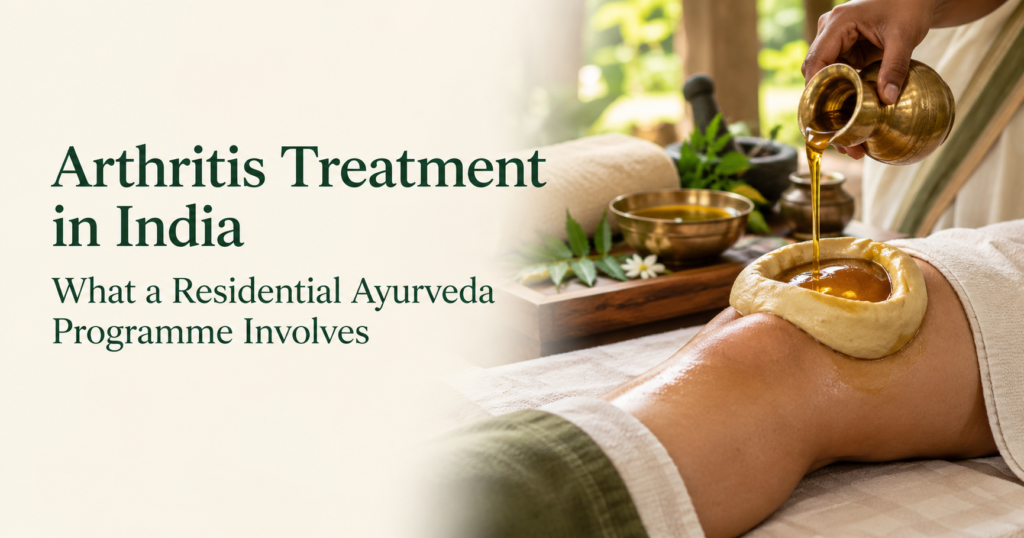
Arthritis treatment in India combines conventional care, such as medicines and physiotherapy, with complementary options like Ayurveda. A residential Ayurveda programme adds supervised oil therapies, Basti, diet and gentle movement over two weeks or more. It does not replace your rheumatologist’s treatment. It works alongside it, with the aim of easing stiffness and supporting daily movement.
Joint pain is one of the most common reasons people in India look for longer-term care. Osteoarthritis is the most frequent joint disease in the country, with reported prevalence between 22% and 39%. A community study across five Indian sites found knee osteoarthritis in 28.7% of participants (Pal et al., Indian Journal of Orthopaedics, 2016).
Many people manage well with medicines and physiotherapy. Others want something more: time to rest the joints, reduce stiffness and change the habits that make pain worse. That is where a residential Ayurveda programme can fit.
This guide explains the main options for arthritis treatment in India, how Ayurveda understands joint pain, which therapies are used, and how a programme works alongside your rheumatologist. Learn more about IVAC’s approach to Ayurvedic arthritis treatment.
Arthritis treatment in India: the options
Arthritis treatment in India usually starts with a doctor’s diagnosis, then combines medicines, physiotherapy and lifestyle changes. Some people add complementary care such as Ayurveda, yoga or diet support. The type of arthritis matters: osteoarthritis and rheumatoid arthritis are different conditions, and each needs its own plan led by a qualified doctor.
| Option | What it involves | Where it fits |
|---|---|---|
| Medicines | Pain relief, anti-inflammatories, and disease-modifying drugs for inflammatory arthritis | The foundation of care, prescribed and monitored by your doctor |
| Physiotherapy | Strengthening, stretching and mobility work | Helps protect joints and keep movement |
| Weight and lifestyle changes | Reducing load on joints, staying active, adjusting posture | Supports every other treatment |
| Joint procedures and surgery | Injections or joint replacement for advanced cases | Decided by an orthopaedic surgeon |
| Residential Ayurveda | Oil therapies, Basti, diet, yoga and rest over two weeks or more | Complementary care alongside your doctor’s treatment |
Table: common arthritis treatment options in India and where Ayurveda fits.
Ayurveda is most useful when it is added to this picture, not used to replace it. Never stop medicines your rheumatologist prescribed. Consult a qualified doctor before making changes.
How Ayurveda views joint pain
Ayurveda links most joint pain to an imbalance of Vata, the dosha of movement, which is dry, cold and light by nature. When Vata builds up in the joints, it brings stiffness, cracking and pain. When undigested residue, called Ama, also settles in the joints, Ayurveda describes swelling, heaviness and morning stiffness.
Ayurvedic texts describe two patterns that are often compared with the two main types of arthritis:
- Sandhigata Vata. Vata settling in the joints, with dryness, cracking and pain on movement. It is commonly compared with osteoarthritis.
- Amavata. Ama combined with Vata, with swelling, heaviness, stiffness and poor digestion. It is commonly compared with rheumatoid arthritis.
These comparisons help explain Ayurvedic thinking, but they are not diagnoses. Your rheumatologist’s diagnosis still guides your care. For the conventional view of the two conditions, read our article on the two main types of arthritis.
This view shapes treatment. For Vata-type pain, therapies focus on warmth, oil and nourishment. Where Ama is present, the doctor first works on digestion and clearing, before using heavier oil therapies.
Ayurvedic treatment for arthritis in India: therapies used
Ayurvedic treatment for arthritis uses local oil therapies on the affected joints, warm herbal poultices, a course of Basti for Vata, and herbal medicines, supported by diet and gentle yoga. The doctor chooses dry or oil-based therapies depending on whether the joint is dry and stiff, or swollen and heavy.
| Therapy | What happens | Typically used when |
|---|---|---|
| Janu Basti, Kati Basti | Warm medicated oil held over the knee or lower back inside a ring of dough | Dry, stiff, painful knees or lower back |
| Abhyanga | Warm herbal oil massage of the whole body | Vata-type pain and stiffness |
| Patra Pinda Sweda | Massage with warm poultices of medicinal leaves | Stiffness and pain without much swelling |
| Valuka Sweda | Dry heat with warm sand poultices | Swelling and heaviness, where oil is avoided at first |
| Basti | A course of medicated oil and decoction enemas | Considered a principal therapy for Vata conditions |
| Lepa | Herbal paste applied over the joint | Local swelling and warmth |
Table: Ayurvedic therapies commonly used for joint pain. Your doctor decides which suit you.
Research on Ayurvedic medicines for arthritis is encouraging but limited. In a 24-week trial of 440 people with knee osteoarthritis, standardised Ayurvedic herbal formulations reduced knee pain and improved function to a degree equivalent to glucosamine and celecoxib. Some participants showed a rise in a liver enzyme, which the researchers said needs further study (Chopra et al., 2013, via Epistemonikos). A small pilot trial of 43 people with rheumatoid arthritis found individualised Ayurveda performed comparably to methotrexate on standard response measures over 36 weeks (Furst et al., Journal of Clinical Rheumatology, 2011).
These studies tested herbal medicines rather than Panchakarma therapies, and both were limited in size or scope. A review by the same Indian research group noted that trials consistently show good safety but often do not show superior effectiveness (Chopra et al., 2010). That is why Ayurveda is best used alongside conventional care.
What a residential arthritis programme looks like
A residential Ayurvedic arthritis programme usually runs for 14 nights or longer. The first days focus on assessment and digestion, the middle phase on joint therapies and a course of Basti, and the final days on recovery and a plan for home. Gentle, supervised movement runs through the whole stay so joints do not stiffen.
Here is how a typical two-week programme unfolds:
- Days 1 to 3: assessment and preparation. The doctor reviews your reports, medicines, pain pattern and digestion. If there is swelling or heaviness, early therapies are dry, such as warm sand poultices, before oil is introduced.
- Days 4 to 11: joint therapies and Basti. Daily local therapies such as Janu Basti or leaf poultices, alongside a course of Basti and gentle oil massage. The doctor adjusts the plan as pain and stiffness change.
- Days 12 to 14: recovery and home plan. Lighter therapies, a gradual return to normal food, and guidance on diet, movement and any medicines to continue at home.
Throughout the stay:
- Warm, easy-to-digest meals that avoid foods your doctor links to stiffness or swelling
- Daily gentle yoga and mobility work, adapted to your joints
- Rest in a warm, quiet setting, since cold and damp often worsen Vata-type pain
If you have limited mobility, tell the centre in advance. Ask about walking distances, steps and support in therapy rooms. [TO FILL: IVAC accessibility details, such as ground-floor rooms or buggy transfers]
Working alongside your rheumatologist
An Ayurvedic arthritis programme should always work alongside your rheumatologist, never replace them. Keep taking the medicines you have been prescribed, share your reports with the Ayurvedic doctor, and tell your rheumatologist about the programme. This matters most for rheumatoid and other inflammatory arthritis, where stopping medicines can allow joint damage to progress.
Before you go:
- Bring recent blood tests, scans and a full list of medicines and doses
- Ask your rheumatologist whether anything should be avoided, such as particular herbs or heat on an inflamed joint
- Agree how you will report any flare during the stay
During the stay:
- Continue every prescribed medicine unless your own doctor tells you otherwise
- Report any new pain, swelling, fever or side effects straight away
- Check before taking any new herbal medicine alongside your current treatment
After you return:
- Share the Ayurvedic doctor’s notes with your rheumatologist
- Keep follow-up appointments and blood tests as scheduled
IVAC’s approach was shaped by its founder, Dr. Talavane Krishna, a Western-trained doctor. IVAC doctors expect guests to continue their prescribed treatment, and plan programmes around it.
Choosing an arthritis treatment centre in India
The best arthritis treatment centre in India for Ayurvedic care is one where doctors read your medical reports, plan joint-specific therapies, review you daily and expect you to continue your prescribed medicines. It should also be physically comfortable for someone with stiff or painful joints, and honest that Ayurveda supports care rather than cures arthritis.
Ask these questions before you book:
- Will a doctor review my diagnosis, reports and medicines before I arrive?
- Which therapies would you use for my type of arthritis, and why?
- How will you adjust treatment if a joint flares during the stay?
- Will I continue my current medicines throughout?
- Are rooms, walkways and therapy areas easy to reach with limited mobility?
- What will you give me to follow at home?
For a wider checklist that applies to any retreat, see how to choose an Ayurveda retreat.
Ayurvedic care for arthritis at IVAC, Mysuru
At Indus Valley Ayurvedic Centre (IVAC), every joint programme starts with a doctor’s review of your diagnosis, reports and medicines, and continues with daily doctor reviews. Therapies are chosen for your joints and adjusted as you respond. IVAC has welcomed guests from more than 50 countries since 1999.
[EXPERT QUOTE NEEDED: one or two lines from an IVAC doctor on how IVAC supports guests with arthritis alongside their rheumatologist]
Your next step: Read about IVAC’s Ayurvedic arthritis treatment and book a free 20-minute call with an IVAC doctor. Have your reports ready. Our doctors will assess your case before recommending any programme.
Frequently asked questions
What is the best treatment for arthritis in India?
The best treatment depends on the type of arthritis and how advanced it is. For most people it combines prescribed medicines, physiotherapy, weight and lifestyle changes, and sometimes procedures. Complementary care such as residential Ayurveda can be added to ease stiffness and support movement, working alongside your rheumatologist rather than replacing their treatment.
Can Ayurveda cure arthritis?
No responsible doctor should promise a cure. Ayurveda may help ease pain and stiffness and support daily movement, and some trials of Ayurvedic medicines have shown encouraging results. It works best as complementary care alongside conventional treatment. Our doctors will assess your case and explain honestly what a programme may and may not do.
How long is an Ayurvedic arthritis programme?
Most residential programmes for joint pain run for 14 nights or longer. That allows a few days of assessment and preparation, a course of joint therapies and Basti, and time for recovery. Shorter stays can offer relief through oil therapies and rest, but they are less suited to long-standing joint problems.
Can I continue my medicines during Ayurvedic treatment for arthritis?
Yes, and you should. Keep taking everything your rheumatologist or doctor has prescribed. Bring a full list of medicines and recent reports, and the Ayurvedic doctor will plan around them. Check before starting any new herbal medicine, and keep your own doctor informed. Consult a qualified doctor before making changes.
Is Ayurveda suitable for rheumatoid arthritis?
Ayurveda can be used as complementary care for rheumatoid arthritis, alongside the disease-modifying medicines your rheumatologist prescribes. Ayurveda describes a similar pattern called Amavata and focuses first on digestion and swelling. Because rheumatoid arthritis can damage joints if untreated, never stop prescribed medicines in favour of Ayurvedic treatment.
What is Janu Basti?
Janu Basti is a local Ayurvedic therapy for the knee. A ring of dough is placed around the knee and filled with warm medicated oil, which is held there for a set time and kept warm. It is commonly used for dry, stiff and painful knees, and is usually given daily over a course.
Key takeaways
- Osteoarthritis is common in India, with reported prevalence of 22% to 39%.
- Ayurveda links joint pain to Vata and Ama, and uses local oil therapies, poultices, Basti and diet.
- Research on Ayurvedic medicines is encouraging but limited, so Ayurveda works best alongside conventional care.
- Never stop prescribed medicines. Choose a centre that reads your reports and works with your rheumatologist.
About the author
Dr. Belaku Chandu is a Senior Ayurvedic Consultant at Indus Valley Ayurvedic Centre (IVAC), Mysuru, and assesses guests and plans their Panchakarma and joint care programmes.
This article is for general information. It does not replace advice from a qualified doctor. Do not stop or change prescribed medicines without your doctor’s advice. Our doctors will assess your case before recommending any programme.