
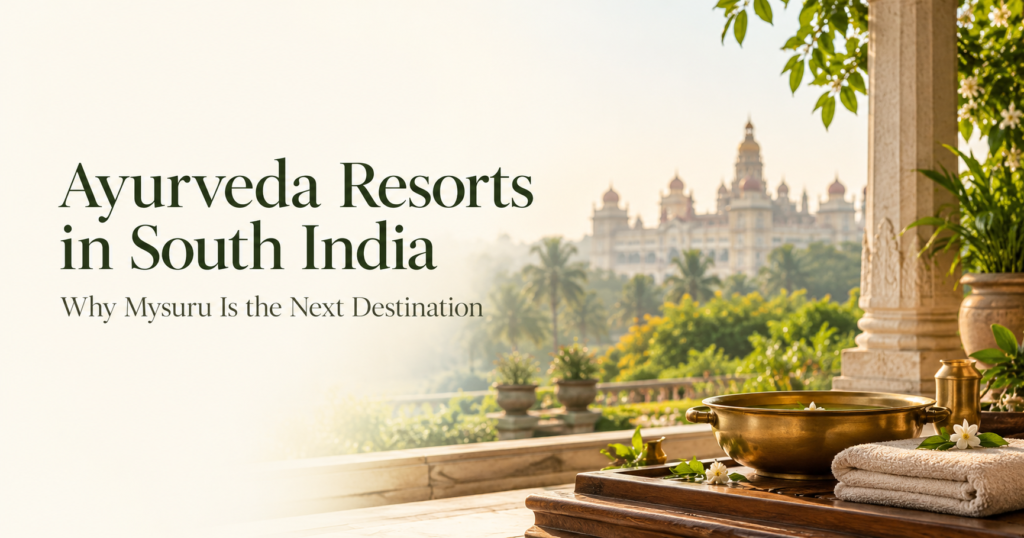
The best Ayurveda resorts in South India combine doctor-led classical treatment with a calm setting that is easy to reach. Mysuru offers all three: a long tradition of Ayurveda and yoga, a mild climate on the Deccan plateau, and a journey of about two hours from Bengaluru by road or rail. It is a destination in its own right for a residential Panchakarma stay.
South India is home to many Ayurveda resorts, and choosing between them can feel overwhelming. Most guests start with a region, then narrow down to a property. That order often hides the real question: where will you receive the best doctor-led care, in a setting that helps you rest?
This guide explains what to look for in Ayurveda resorts in South India, why Mysuru stands out as a destination of its own, and what a classical programme there involves. It is written by the doctors at Indus Valley Ayurvedic Centre (IVAC), an Ayurveda retreat in Mysuru since 1999.
What makes a good Ayurveda resort in South India
A good Ayurveda resort in South India puts treatment first and comfort second, while doing both well. Look for qualified doctors who assess every guest, classical Panchakarma rather than a spa menu, food prepared to your plan, a calm natural setting, and honest information about length of stay and price. Location matters, but it comes after care.
The category is growing quickly. The wellness segment of India’s Ayush services, which includes resorts and spas offering Ayush treatments, grew at 21.29% a year, according to a 2026 study by the Research and Information System for Developing Countries (PSU Connect, citing PIB). More choice makes careful comparison more important.
Five essentials to check:
- Doctors on site who assess you before treatment and review you daily
- Classical Panchakarma with clear preparation, main therapy and recovery stages
- Food as treatment, cooked fresh and matched to your programme
- A setting that supports rest, quiet and green, with time built in for doing nothing
- Transparency about stay length, inclusions and what you can realistically expect
For the full 10-point version, read our guide on how to choose an Ayurveda retreat in India.
Mysuru’s Ayurvedic and yoga heritage
Mysuru has one of the deepest traditions of Ayurveda and yoga in India. It is home to what is considered the country’s oldest academic institute teaching Ayurveda, founded in 1908, and to the royal yoga school that shaped the styles of yoga practised around the world today. Few cities can offer that heritage alongside a calm setting for treatment.
Ayurveda. The Government Ayurveda Medical College and Hospital began in 1908 at the Maharaja’s Sanskrit Pathashala, and is described as India’s oldest academic institute teaching Ayurvedic medicine (Deccan Herald). For over a century, Mysuru has trained Ayurvedic doctors and kept classical practice alive.
Yoga. In 1933, Maharaja Krishnaraja Wadiyar IV asked the yoga master T. Krishnamacharya to open a Yogashala in a wing of the Jaganmohan Palace. His students, including B.K.S. Iyengar and K. Pattabhi Jois, went on to develop styles such as Ashtanga Vinyasa yoga that are now practised worldwide (Live History India).
Culture. Mysuru is also a city of palaces, gardens and the ten-day Dasara festival each autumn, which makes rest days between therapies easy to fill gently, or to leave empty.
This heritage is not just history. It shapes how Ayurveda and yoga are still taught and practised in the city, and IVAC is proud to be part of it.
Climate, calm and setting
Mysuru sits about 770 metres above sea level on the Deccan plateau, which gives it a mild climate for most of the year (Dhamma.org, About Mysuru). Average monthly temperatures range from about 22.5°C in December to 28.2°C in April, the warmest month (Kupi weather data). Days are rarely extreme, which suits long stays and outdoor yoga.
| Season | Months | What to expect |
|---|---|---|
| Cool and dry | October to February | Pleasant days and cooler evenings; popular for longer stays |
| Warm | March to May | Warmer afternoons; mornings and evenings stay comfortable |
| Monsoon | June to September | Green landscapes and steady rain; a quiet, restful time |
Table: Mysuru’s seasons at a glance. Your doctor can suggest timing based on your programme.
Ayurveda links each season to different therapies, so there is no single best month. Classical texts, for example, describe the rainy season as a traditional time for Basti. Your doctor will advise on timing.
Beyond the weather, the setting matters. A residential Ayurveda stay works best in quiet green surroundings, away from traffic and noise, with space to walk and rest between therapies. Mysuru offers this within easy reach of a major city, which is rare.
Ayurveda resort vs Ayurveda centre: the difference
An Ayurveda resort is mainly a holiday property that offers Ayurvedic therapies; an Ayurveda centre is mainly a treatment programme that offers comfortable accommodation. When you search for Ayurveda resorts in South India, you will find both under the same label, so it helps to know which one you are looking at.
Three quick ways to tell them apart:
- Who plans your day? At a resort, you choose from a spa menu. At a centre, a doctor prescribes your therapies.
- How often do you see a doctor? At a centre, daily. At a resort, often only on request.
- What does the kitchen cook? A centre prepares meals to each guest’s programme; a resort usually runs a restaurant menu.
If you want rest with some Ayurveda, a resort may be enough. If you want Panchakarma or help with a specific concern, choose a doctor-led centre, ideally one that also offers the comfort of a resort. Our checklist on how to choose an Ayurveda retreat in India includes a full side-by-side comparison.
Classical treatments at a Mysuru retreat
A doctor-led retreat in Mysuru offers the full range of classical Ayurvedic treatment: Panchakarma programmes for detox and rejuvenation, therapies such as Abhyanga, Shirodhara and Udvartana, and programmes focused on weight, stress, joints and digestion. Each stay is built around a doctor’s assessment, with daily yoga and food prepared to your plan.
| Programme | What it focuses on | Learn more |
|---|---|---|
| Panchakarma | Preparation, main cleansing therapy and recovery | Panchakarma treatment |
| Detox | A supervised Ayurvedic cleanse | Ayurvedic detox programme |
| Rejuvenation | Restoring energy and resilience after cleansing | Rejuvenation |
| Weight management | Digestion, Kapha balance and lasting habits | Weight management |
| Stress and sleep | Calming therapies such as Shirodhara, routine and rest | Stress management |
| Joint care | Local oil therapies and Basti for stiffness and pain | Arthritis care |
Table: classical programmes offered at IVAC, Mysuru.
Whatever the programme, the principles are the same: a doctor’s assessment first, a personal plan, daily review, and care that runs alongside any medicines your own doctor prescribes.
Planning your visit
Planning an Ayurveda stay in Mysuru is simple. Fly into Bengaluru, then travel about two hours by road or rail. Speak with a doctor before you book so they can recommend the right programme length, usually around 14 nights for a full Panchakarma. Arrive by early afternoon so you can settle in before therapies begin.
Getting there:
- By air: Most international guests fly into Kempegowda International Airport, Bengaluru, then continue by road.
- By road: The Bengaluru-Mysuru Expressway cut the city-to-city drive to about 75 minutes, according to the Government of India (New India Samachar, 2023).
- By rail: The fastest trains from Bangalore take a little over two hours. See our guide to an Ayurveda retreat near Bangalore for routes and timings.
Before you arrive:
- Book a call with a doctor and share your reports and medicines
- Choose dates that let you rest, not squeeze in work
- Pack loose cotton clothing, comfortable footwear and a book
- International guests can check whether the Ayush visa applies to them
Your Ayurveda stay at IVAC, Mysuru
Indus Valley Ayurvedic Centre (IVAC) has welcomed guests from more than 50 countries since 1999. Every programme is doctor-led, follows classical Panchakarma, and runs alongside the medicines your own doctor prescribes. IVAC was founded by Dr. Talavane Krishna, a Western-trained doctor (MBBS, FFARCS UK).
[EXPERT QUOTE NEEDED: one or two lines from Dr. Talavane Krishna on why Mysuru is the right home for classical Ayurveda]
Your next step: Explore IVAC, an Ayurveda retreat in Mysuru, and book a free 20-minute call with an IVAC doctor. Our doctors will assess your case before recommending any programme.
Frequently asked questions
Which is the best Ayurveda resort in South India?
The best Ayurveda resort in South India is one that puts doctor-led classical treatment first and offers a calm, comfortable setting. Look for a doctor’s assessment, genuine Panchakarma, food prepared to your plan and clear pricing. Mysuru is worth considering for its long Ayurvedic tradition, mild climate and easy access from Bengaluru.
When is the best time for Ayurveda in Mysuru?
Ayurveda can be practised in Mysuru year-round because the climate is mild. October to February is cool and dry, March to May is warmer, and June to September brings the monsoon, which classical texts link to therapies such as Basti. Your doctor will suggest the best timing for your programme.
How is an Ayurveda resort different from an Ayurveda centre?
An Ayurveda resort is mainly a holiday property with Ayurvedic therapies on offer. An Ayurveda centre is built around doctor-led treatment, with daily reviews, prescribed therapies and meals prepared to each guest’s programme. For Panchakarma or a specific health concern, a doctor-led centre is the better choice.
How do I get to Mysuru for an Ayurveda retreat?
Most guests fly into Kempegowda International Airport in Bengaluru, then travel to Mysuru by road or rail. The Bengaluru-Mysuru Expressway brought the city-to-city drive to about 75 minutes, and the fastest trains take a little over two hours. Allow extra time from the airport, which is north of Bengaluru.
How long should I stay at an Ayurveda resort?
For a full Panchakarma programme, plan on about 14 nights, which covers preparation, the main therapy and recovery. Shorter stays of 3 to 7 nights suit a reset with oil therapies, diet, yoga and rest. Your doctor will recommend a length after understanding your health and goals.
Is Mysuru good for yoga as well as Ayurveda?
Yes. Mysuru has a deep yoga heritage. In 1933 the Maharaja of Mysore opened a Yogashala at the Jaganmohan Palace under T. Krishnamacharya, whose students developed styles practised worldwide. Many Ayurveda programmes in Mysuru include daily yoga as part of treatment.
Key takeaways
- Choose an Ayurveda resort in South India on the quality of doctor-led care first, and location second.
- Mysuru is home to India’s oldest academic institute teaching Ayurveda and to a royal yoga tradition.
- Its mild plateau climate suits long stays in any season.
- A full Panchakarma needs about 14 nights; Mysuru is about two hours from Bengaluru by road or rail.
About the author
Dr. Belaku Chandu is a Senior Ayurvedic Consultant at Indus Valley Ayurvedic Centre (IVAC), Mysuru, and assesses guests and plans their Panchakarma programmes.
This article is for general information. It does not replace advice from a qualified doctor. Our doctors will assess your case before recommending any programme.