Definition
Psoriasis is an autoimmune, non-contagious, chronic inflammatory skin disorder resulting in hyper-proliferation of the skin. It is characterized by dry, raised, rough, red areas covered with fine silvery scales.

Ayurvedic support for chronic inflammatory skin concerns, dry raised patches, flaky lesions, itching, and long-term skin balance.
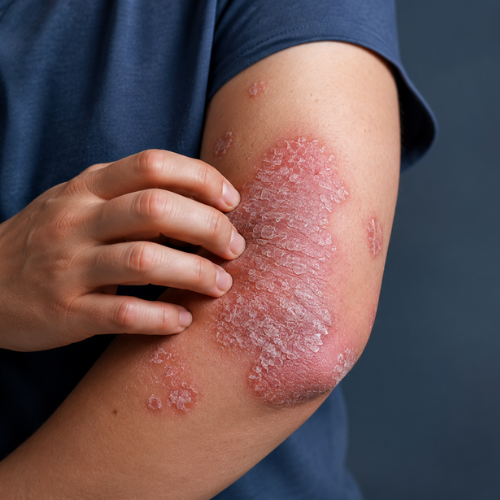
Ayurvedic support for chronic inflammatory skin concerns, dry raised patches, flaky lesions, itching, and long-term skin balance.
Psoriasis is an autoimmune, non-contagious, chronic inflammatory skin disorder resulting in hyper-proliferation of the skin. It is characterized by dry, raised, rough, red areas covered with fine silvery scales.
In Ayurveda, psoriasis can be correlated to Kitiba, a variety of Kshudra Kushta and a Maha Gada, meaning it can be difficult to manage. It involves disturbance of seven body factors: three Doshas, skin, blood, Mamsa, and lymphatic fluid.
Signs and symptoms include dryness, flaky skin lesions, raised rough red areas, itching, and occasional bleeding from the rashes. If not addressed effectively, it may affect the joints and lead to psoriatic arthritis.
Ayurveda focuses on improving Agni, removing Ama, correcting Dhatwagni, strengthening the Dhatus, and maintaining the equilibrium of the seven disturbed factors involved in Kitiba.
The Ayurvedic line of treatment for psoriasis focuses on improving Agni, removing Ama, correcting Dhatwagni, strengthening the Dhatus, maintaining equilibrium of the seven factors, and supporting the skin through Panchakarma, rejuvenation, diet, lifestyle, Yoga, and Daivavyapashraya measures.
The treatment begins with improving digestive fire because constant imbalance in diet and lifestyle can lead to Mandagni, poor digestion, and formation of Ama.
Ama is addressed through cleansing and metabolic correction because it disturbs Rasa, Rakta, Mamsa, and Lasika, eventually contributing to Kitiba.
The line of treatment includes correcting Dhatu metabolism and strengthening the Dhatus involved in the skin, blood, muscle tissue, and lymphatic channels.
A complete Panchakarma program may include Snehapana, Vamana, and Virechana to help remove toxins, improve metabolism, and support long-term skin balance.
Rejuvenation treatments such as Abhyanga and Dhara are used to support recovery, calm the system, and strengthen the body after detoxification.
Management includes dietary regulations, daily regimens, Yoga, Asana, Pranayama, and Meditation to reduce recurrence and support healthier skin.
Traditional supportive measures such as Mantra Chikitsa and Homa may be included as part of the broader Ayurvedic approach where appropriate.
Every individual’s skin condition, digestion, lifestyle, stress pattern, constitution, and severity of psoriasis are different. At Indus Valley Ayurvedic Centre, our Ayurvedic doctors assess your condition and suggest a personalized line of care.